
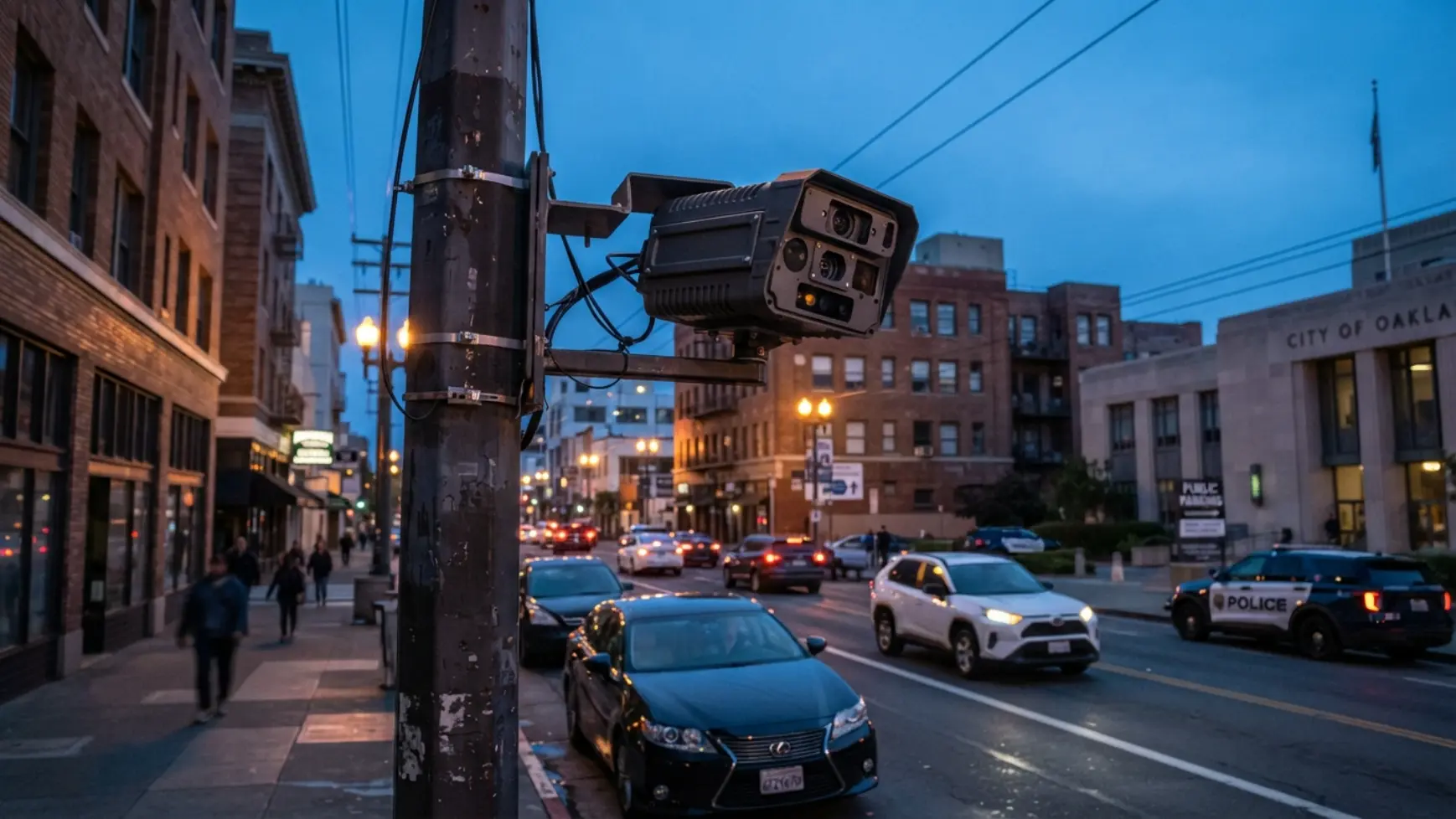
Cities across the United States are collecting massive volumes of vehicle data through AI-enabled camera networks, giving police the ability to trace a car’s movements across neighborhoods, cities, and even state lines within seconds. Supporters describe the systems as one of the most effective modern tools for solving crimes and locating missing people. Critics call them a major step toward routine mass surveillance.
At the center of that national debate is Flock Safety, an Atlanta-based company that has rapidly grown by selling automated license plate reader systems to police departments, neighborhood associations, schools, and private organizations. Its cameras are often mounted discreetly on roadside poles and record images of passing vehicles, transforming each sighting into a searchable data point.
According to the company, its platform now processes around 20 billion license plate scans every month, underscoring the scale at which vehicle movement data is being collected across the country.
Table of Contents
What the cameras actually capture
The technology does far more than read a license plate number. Each scan can also capture details such as a vehicle’s color, make, model, and other visible characteristics, including bumper stickers, roof racks, or gun racks. That information is then stored in a cloud-based system that law enforcement agencies can search using a full plate number, a partial plate, or even descriptive terms.
In practical terms, the platform works as a large-scale pattern-matching system. Police can review a vehicle’s recent route, set alerts for cars connected to investigations, and, depending on local policy, access data gathered by agencies in other jurisdictions. Flock says its system does not use facial recognition, and the company maintains that images are generally deleted after about 30 days unless a different retention rule has been adopted.
Why police departments strongly support the system
Law enforcement agencies have embraced the technology because of the speed and range it offers during investigations. Instead of relying only on eyewitness accounts or limited local camera footage, officers can quickly search for a vehicle across a wider network and reconstruct where it has been seen.
Flock CEO Garrett Langley has said the system was tied to about one million arrests last year, reflecting just how deeply the product has become embedded in modern policing strategies. Police leaders in many communities argue that the cameras help solve robberies, find stolen vehicles, identify suspect vehicles after violent crimes, and support time-sensitive searches for abducted or missing persons.
For departments facing staffing shortages or rising pressure to solve cases quickly, automated license plate readers are increasingly seen as force multipliers.
Why civil liberties groups are alarmed
The same features that make the system useful to investigators are fueling growing unease among privacy advocates, legal experts, and some residents. Unlike traditional surveillance tools aimed at specific suspects, these camera networks collect data on virtually every passing vehicle, regardless of whether the driver is connected to any crime.
That broad and constant collection is the core of the criticism. Opponents argue that such systems normalize indiscriminate tracking and create the infrastructure for governments to monitor people’s movements at scale. Civil liberties advocates say a tool this powerful should be restricted to the most serious investigations, not routine policing.
The broader concern is not only what the technology can do now, but what it could enable over time if retention periods expand, data sharing widens, or oversight weakens.
Troy, New York becomes a flashpoint
The debate has become especially intense in Troy, New York, where a network of 26 cameras triggered fierce public backlash. At a city council meeting that ran late into the night, residents sharply criticized city officials and warned that the system represented a dangerous erosion of privacy.
Several residents argued that the city was enabling a surveillance model that treats everyone as trackable by default. The emotional tone of the meeting reflected how deeply the issue now resonates in local politics, particularly in communities where public trust in government surveillance is already fragile.
Mayor Carmella Mantello defended the system, pointing to cases in which the cameras helped solve crimes and locate missing people. But her comparison between the camera network and everyday smartphone tracking further inflamed the room, highlighting how divided the public has become on the question of acceptable surveillance.
A nationwide backlash is already underway
Troy is not an isolated case. Since early last year, roughly 50 cities and counties have either canceled their Flock contracts or shut down the cameras altogether. The resistance is politically diverse, drawing support from privacy-focused liberals, civil-libertarian groups, and conservatives skeptical of government data collection.
That cross-ideological pushback is significant. It suggests the debate is no longer confined to activist circles or academic privacy discussions. Instead, it is becoming a mainstream governance issue involving local councils, police oversight, procurement transparency, and constitutional concerns.
The data-sharing problem
One of the biggest points of friction is data sharing between agencies. Interoperability is one of Flock’s strongest selling points because it lets departments search beyond their own camera network. But that same capability raises difficult questions about who can access the data, for what purpose, and with what level of accountability.
In Dayton, Ohio, officials suspended the use of their cameras after learning that outside agencies had accessed local data thousands of times for immigration-related searches. The case became a warning sign for municipalities that may have approved the technology for local crime prevention but had not fully accounted for how widely the data could travel.
This is where the policy debate becomes especially serious. A city may believe it is deploying a local public safety tool, but once information is available across jurisdictions, the practical consequences become much larger than any single council vote.
Flock says the public often misunderstands the technology
Flock Safety has argued that much of the backlash comes from confusion about how the system works. Company representatives say people often see the cameras without understanding that they are designed to capture vehicle information rather than identify drivers through facial recognition.
The company also says it has built audit logs, permission controls, and other safeguards to reduce misuse. At the same time, company officials have acknowledged that any centralized repository of vehicle movement data is inherently sensitive and understandably unsettling to many people.
That acknowledgment matters, but it has not ended the debate. Critics remain concerned that misuse can still happen, whether through improper personal searches, weak supervision, or gradual expansion of surveillance powers beyond their original justification.
Citizens and technologists are now fighting back
Resistance is also emerging outside city halls. Software engineer Will Freeman created DeFlock, a crowdsourced map of camera locations that reportedly tracks more than 100,000 devices nationwide. The project reflects a new form of digital counter-surveillance, where technologists use open-source tools and public reporting to expose where these systems are installed.
That response shows how the surveillance debate is evolving. It is no longer only about whether cities should buy these systems. It is also about whether residents should be able to see, map, question, and challenge the infrastructure that watches public roads.
The bigger question cities still have not answered
The unresolved issue is not whether automated license plate readers can help solve crimes. In many cases, they clearly can. The harder question is whether a system capable of tracing ordinary people’s movements at scale can be used in a way that remains limited, accountable, and consistent with civil liberties.
That question is now playing out in Troy, where the political fight is still unfolding. After the city council voted to block funding, the mayor declared a state of emergency to renew the contract, leading to a lawsuit. Officials have since agreed to a 60-day pause to review how the system is being used, while police have temporarily suspended data sharing with out-of-state agencies.
The standoff captures the national moment. Many city leaders do not want to deprive police of a tool they see as effective. At the same time, residents increasingly want hard limits, stronger oversight, and clear rules before a powerful surveillance system becomes a permanent part of civic life.
As more cities adopt AI-based vehicle tracking, that balance between safety and privacy is likely to define the next phase of the debate.