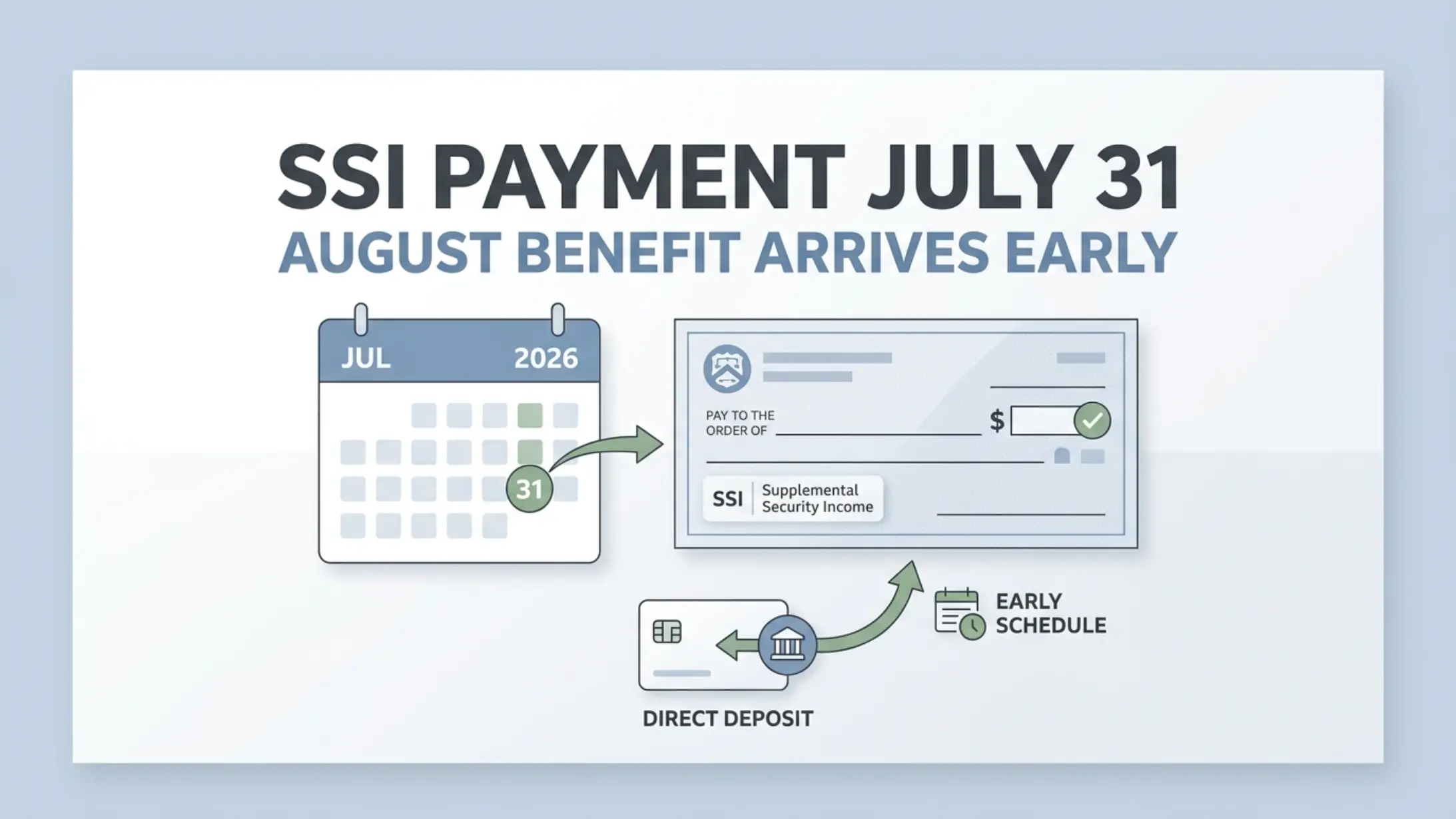
Millions of Americans will receive a federal benefit payment earlier than usual at the end of July, as the Social Security Administration adjusts its schedule because of the calendar.
Supplemental Security Income recipients are due to receive their August 2026 payment on Friday, July 31. The money is being issued one day before its normal date because August 1 falls on a Saturday. Under SSA rules, when a scheduled payment date lands on a weekend or federal holiday, benefits are generally paid on the preceding business day.
The July 31 deposit is not an additional or bonus payment. It is the regular SSI payment for August, delivered ahead of schedule.
Table of Contents
Who Will Be Paid on July 31?
The payment is intended for people enrolled in the Supplemental Security Income program. SSI provides monthly assistance to adults and children who have limited income and financial resources and who meet the program’s age, blindness or disability requirements.
People aged 65 or older may qualify without having a disability, provided they meet the program’s financial and other eligibility conditions.
Unlike Social Security retirement, survivor and Social Security Disability Insurance benefits, SSI eligibility is not based on how long a person worked or how much they paid in Social Security taxes. SSI is financed through general federal revenues rather than Social Security payroll taxes.
SSA data for June 2026 showed approximately 7.324 million SSI recipients. Of that total, around 3.8 million were aged 18 to 64, 2.506 million were aged 65 or older and just over 1 million were children younger than 18.
Why Is the August SSI Payment Early?
SSI benefits are normally paid on the first day of each month. August 1, 2026, however, falls on a Saturday, when banks and federal offices generally do not conduct regular business.
As a result, the SSA’s official payment calendar moves the August SSI payment to Friday, July 31.
Recipients should therefore understand the schedule as follows:
- July’s SSI payment was issued on Wednesday, July 1.
- August’s SSI payment will be issued on Friday, July 31.
- There is no separate SSI payment scheduled for August 1.
Receiving two deposits during July does not mean beneficiaries are getting an extra month of assistance. One payment covers July and the other covers August.
How Much Can SSI Recipients Receive in 2026?
The maximum federal SSI payment increased in 2026 following a 2.8% cost-of-living adjustment.
The maximum monthly federal amounts are:
| Recipient category | Maximum monthly SSI payment |
|---|---|
| Eligible individual | $994 |
| Eligible couple | $1,491 |
| Essential person | $498 |
An essential person is someone who lives with an SSI recipient and provides necessary care or assistance under specific legacy eligibility rules.
These figures are federal maximums, not guaranteed payment amounts. A person’s actual benefit may be lower depending on countable income, living arrangements, support received from other people and, in some cases, the income of a spouse or parent.
Average SSI Payment Was $738.10
The average SSI payment in June 2026 was $738.10, according to the SSA’s latest monthly statistical snapshot.
Average payments varied considerably by age:
- Recipients younger than 18 averaged $874.50.
- Recipients aged 18 to 64 averaged $785.93.
- Recipients aged 65 or older averaged $611.12.
The averages exclude retroactive payments, while the total payment figures reported by the agency may include them.
Some States Add Extra SSI Money
Certain states provide supplementary payments in addition to the federal SSI benefit. These payments are generally designed to help recipients meet additional food, housing or personal-care expenses.
The availability and amount of a state supplement depend on where the recipient lives, their living arrangement and the rules applied by that state. Some states administer their own supplemental programs, while the SSA administers supplements for others.
Recipients should not assume that the federal maximum is the final amount available in their state. They may need to check their benefit notice or contact the agency responsible for SSI supplementation where they live.
How SSI Payments Are Delivered
Federal benefits are primarily distributed electronically. Most SSI recipients receive their money through one of two methods.
Direct Deposit
The payment can be deposited directly into a checking or savings account. Recipients may update their bank information through an eligible personal Social Security account, through their financial institution or by contacting the SSA.
The SSA’s national telephone number is 1-800-772-1213. Representatives are generally available Monday through Friday between 8 a.m. and 7 p.m. local time.
Beneficiaries should never provide bank details in response to unsolicited calls, emails or text messages. Banking information should be updated only through verified government channels or the recipient’s financial institution.
Direct Express Card
People who do not have a bank account may receive benefits through the Direct Express debit card. Federal funds are electronically loaded onto the prepaid card and become available on the scheduled payment date.
There is no enrollment fee or minimum balance requirement. Enrollment assistance is available through the Treasury’s Electronic Payment Solution Center at 1-800-333-1795 or through the SSA at 1-800-772-1213.
What to Do If the Payment Does Not Arrive
Direct deposits are normally available on the scheduled date, although the exact posting time can depend on the recipient’s bank or financial institution.
A beneficiary who does not see the July 31 payment should first check with their bank or Direct Express account provider. They should also confirm that their account remains open and that the SSA has the correct payment information.
The SSA advises beneficiaries to allow three additional mailing days before contacting the agency about a missing scheduled payment. That guidance is particularly relevant to anyone who still receives an exceptional non-electronic payment.
Other Social Security Payments Follow Different Rules
The July 31 payment applies specifically to SSI. It should not be confused with the usual schedule for Social Security retirement, survivor or disability benefits.
For many beneficiaries, those payments are distributed according to their date of birth:
- Birthdays from the 1st through the 10th are generally paid on the second Wednesday.
- Birthdays from the 11th through the 20th are generally paid on the third Wednesday.
- Birthdays from the 21st through the 31st are generally paid on the fourth Wednesday.
Different rules may apply to people who began receiving Social Security before May 1997 or who receive both Social Security and SSI.
The Bottom Line
SSI beneficiaries are scheduled to receive their August 2026 payment on Friday, July 31, because August 1 falls on a Saturday.
Although the deposit arrives during July, it is not an extra payment. Recipients should budget it as their regular August benefit, particularly because another SSI payment will not be issued at the beginning of August.