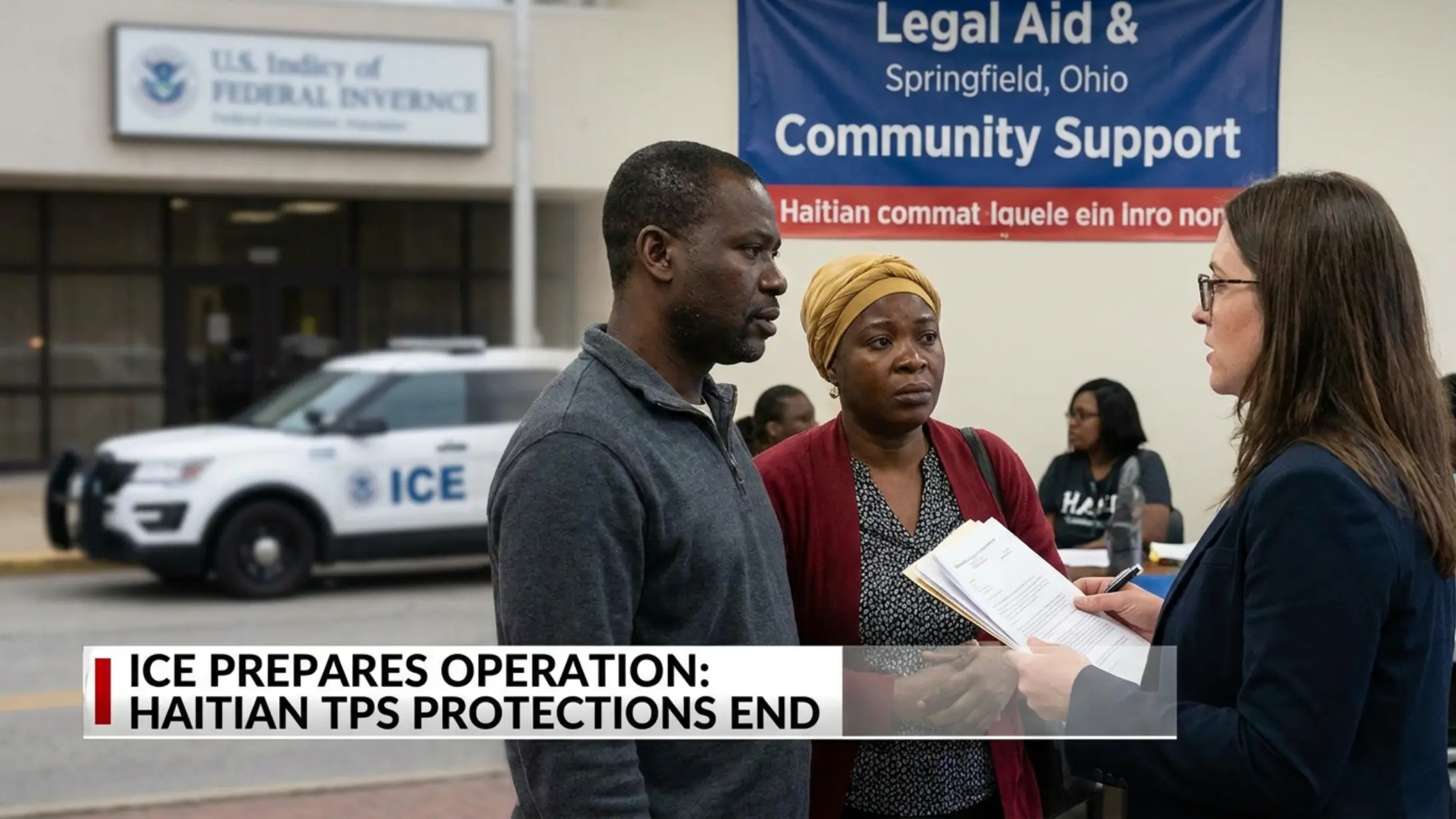
U.S. Immigration and Customs Enforcement is preparing to intensify arrests and deportations involving Haitian migrants as more than 300,000 people face the loss of Temporary Protected Status, according to federal documents and agency sources familiar with the plans.
The enforcement preparations follow a June 25 Supreme Court ruling that cleared the Trump administration to terminate deportation protections and work authorization for Haitian and Syrian TPS holders. The court’s binding mandate was expected to be transmitted to lower courts on Monday, July 27, removing one of the final procedural barriers to implementing the ruling.
Internal planning reportedly includes operations in Ohio, where Springfield and other cities have developed sizeable Haitian communities in recent years. The documents also indicate that federal officials are considering quickly placing some detained migrants on deportation flights to Haiti.
However, the exact size, timing and geographic reach of the operation remain unclear. The Department of Homeland Security has not publicly announced a nationwide raid or provided a complete list of locations where enforcement could occur.
Table of Contents
ICE Operations Could Begin This Week
The proposed enforcement increase could begin as early as this week, although the plans remain fluid and may change, according to two ICE sources and federal documents obtained by CBS News.
Ohio appears to be one of the primary areas under consideration. Springfield, in particular, has become nationally associated with Haitian immigration after thousands of Haitians moved to the region for employment and other opportunities.
The preparations reportedly involve identifying Haitian nationals who no longer have legal protection from deportation and moving quickly against individuals who already have final removal orders.
DHS declined to discuss the operational details, saying that the department does not comment on ongoing or future enforcement actions. The agency defended the decision to end Haiti’s TPS designation, arguing that the program was intended to provide temporary protection rather than permanent legal status.
What the Supreme Court Decided
In a 6–3 decision issued on June 25, the Supreme Court overturned lower-court orders that had prevented the administration from ending TPS for Haitians and Syrians.
The majority concluded that federal law broadly limits judicial review of decisions made by the Homeland Security secretary concerning the designation, extension or termination of TPS programs.
The ruling also rejected, at the preliminary stage of the litigation, claims that the termination of Haiti’s designation was motivated by racial discrimination. The majority said the available evidence was not sufficient to establish that race motivated the administration’s decision.
The three liberal justices dissented. Justice Elena Kagan argued that lower courts should have been permitted to review whether the administration followed legally required procedures and whether discriminatory considerations affected the decision.
The ruling does not necessarily end every underlying legal challenge, but it allows the administration to move forward with terminating the protections while litigation continues.
More Than 300,000 Haitians Affected
More than 300,000 Haitian nationals are expected to be affected by the termination of TPS. Some estimates place the total closer to 350,000, depending on the registration period and government data being used.
TPS allows eligible foreign nationals from countries experiencing armed conflict, natural disasters or other extraordinary conditions to live and work temporarily in the United States. Congress created the program in 1990.
Haiti was first designated for TPS following the catastrophic 2010 earthquake. The designation was later renewed or expanded because of political instability, gang violence, food insecurity, inadequate healthcare and humanitarian emergencies.
The Trump administration maintains that the program has been extended far beyond its temporary purpose. Immigration advocates counter that conditions in Haiti remain too dangerous for large-scale deportations.
Losing TPS Does Not Mean Immediate Deportation for Everyone
The end of TPS does not mean that every Haitian beneficiary can be deported immediately.
People who already have final removal orders may face the most immediate enforcement risk. Haitian nationals who do not have removal orders are generally entitled to appear before an immigration judge before deportation can occur.
Some affected individuals may also remain legally protected through another immigration category. This could include asylum, lawful permanent residence, a valid visa, a pending immigration application or another form of humanitarian relief.
TPS holders whose protection expires will generally lose their associated employment authorization unless they have a separate legal basis to work in the United States. They may also become eligible for arrest and removal proceedings once their TPS status is no longer valid.
Immigration attorneys and advocacy organizations are urging Haitian families to review their records and seek qualified legal advice rather than assuming that every TPS beneficiary has the same immigration options.
Haitian Communities Face Growing Fear
The enforcement reports have intensified anxiety in Haitian communities across Florida, Ohio, New York, Massachusetts, Connecticut and other states.
Community organizations say families are concerned about workplace arrests, traffic stops, school pickups and separation from U.S.-citizen children. Employers are also preparing for the possibility of losing experienced workers in healthcare, hospitality, construction, manufacturing and eldercare.
South Florida, which has one of the largest Haitian populations in the country, is expected to be especially affected. Healthcare and long-term care providers in several states have warned that losing Haitian employees could deepen existing staffing shortages.
Springfield could also experience a significant economic and social impact. Haitian workers have filled jobs in local manufacturing, logistics, healthcare and service businesses, while their children have enrolled in area schools.
Deportations Raise Safety Concerns
Any increase in deportations would return migrants to a country facing an acute security and humanitarian crisis.
Armed groups control significant parts of Haiti, while violence, displacement and political instability continue to affect daily life. The U.S. State Department advises Americans not to travel to Haiti because of kidnapping, violent crime, civil unrest and limited healthcare services.
The security situation in Port-au-Prince has also complicated deportation logistics. U.S. authorities have generally limited some deportation flights to Cap-Haïtien in northern Haiti because of instability around the capital.
Immigrant-rights groups argue that sending large numbers of people back under these conditions could expose deportees to kidnapping, extortion, homelessness or violence.
The administration says TPS decisions must be based on statutory requirements and that temporary immigration programs cannot become permanent substitutes for congressional immigration reform.
What Happens Next
The immediate question is whether ICE will proceed with a coordinated enforcement campaign this week and how broadly it will be implemented.
The agency’s preparations indicate that Haitian nationals with expired TPS and existing removal orders could become an early priority. Still, DHS has not confirmed the reported operation’s final scope or announced a public start date.
Legal challenges are also expected to continue, while members of Congress and immigration advocates push for legislative protection for Haitian nationals.
For now, the Supreme Court ruling gives the administration broad authority to terminate Haiti’s TPS designation and begin enforcement against people who do not have another lawful immigration status.
The situation remains fluid, and further court orders, federal guidance or congressional action could change how and when the termination is enforced.